
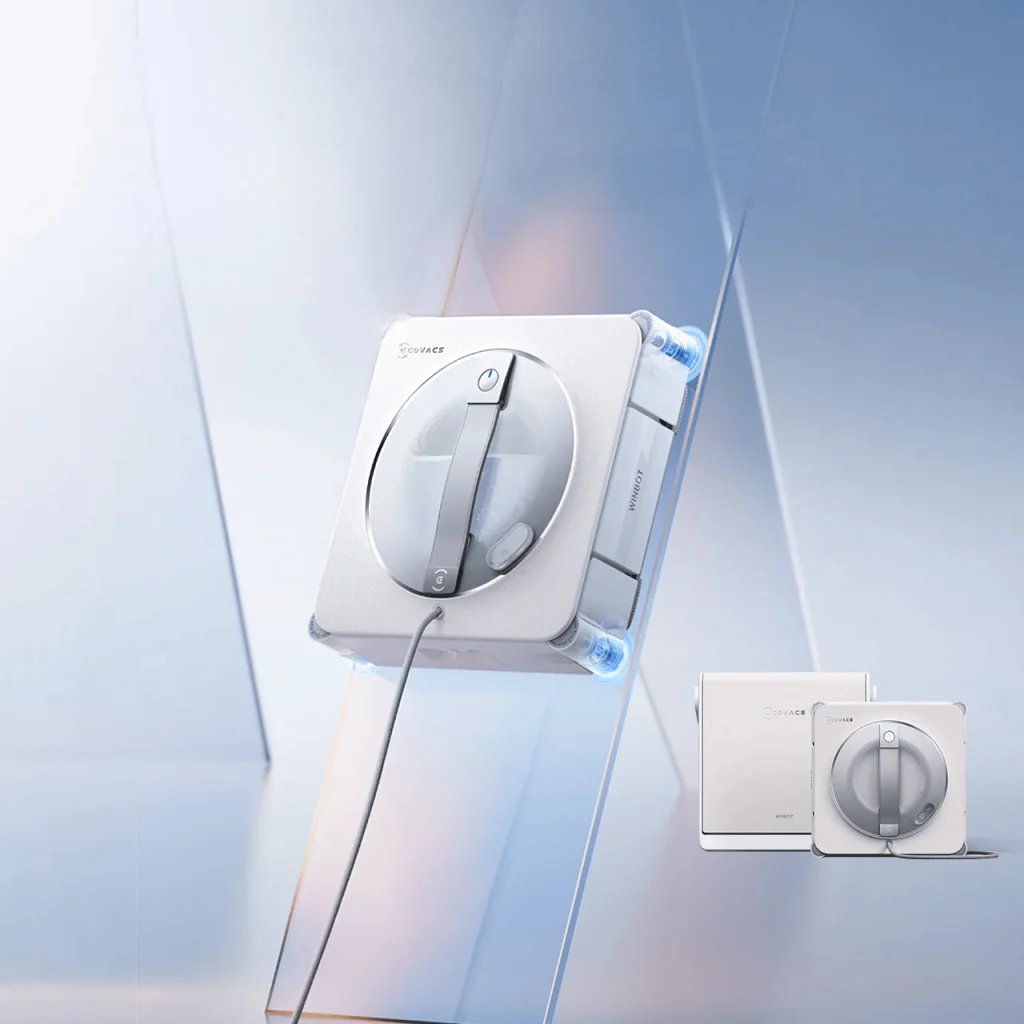
An ECOVACS window cleaning robot is built mainly for vertical residential glass, and it works there. On a sloped skylight or a glass roof, suction margin, tether logic and dirt load decide whether it holds, so buyers rarely get a clean yes or no.
The ECOVACS WINBOT line is probably the most searched name in this category. People typing “ECOVACS window cleaning robot” usually have a flat window in mind, then discover a skylight and wonder if the same machine can be pointed upward. Here is the honest breakdown after running both types of glass on real jobs.
What does an ECOVACS window cleaning robot actually do well?
WINBOT units cling to glass with a vacuum pump and crawl on two tracks. Published figures for the W3 class land around 5000 Pa of suction, roughly 2.2 kg body weight, and a 3000 mAh battery that runs about 80 to 100 minutes in standard mode. On clean vertical glass that is enough. Add a 30 degree tilt and rainwater runoff, and the safety factor shrinks fast.
We have covered this machine in detail before. If you want the hardware side by side, the ECOVACS WINBOT W3 review walks through the suction test numbers and the edge-detection behaviour on framed glass.
What suction strength do you need on a skylight?
Flat vertical glass needs the pump to beat gravity sideways. A 30 degree skylight adds a normal force component, so a fraction more suction is needed to resist sliding, but the bigger issue is dust. Roof glass collects pollen, grit and bird droppings that a window rarely sees. A machine sized for a clean bedroom window will clog a filter on a roof panel faster than you expect.
- Vertical window: 2500-3000 Pa is enough for light dust.
- Sloped skylight (15-30 degrees): budget 4000 Pa and up with a real tether.
- Glass roof / atrium: use a machine designed for it, not a hand-held window unit.
Where the ECOVACS approach stops working
The failure mode is not dramatic. The unit usually does not fall. It stalls. Once the pump filter loads with grit, suction drops, the tracks slip a centimetre, the machine re-corrects, and cleaning time doubles. On a large skylight this turns a 15 minute job into a 40 minute one, and you are standing on a ladder the whole time.
That is the part buying pages skip. A consumer window robot assumes you can reach the glass. A skylight often sits above a stairwell, over a kitchen island, or on a pitched roof where a person either cannot stand or should not. The machine is only half the problem. Placement is the other half.
How do skylight-specific robots differ?
Purpose-built skylight and glass-roof robots solve the reach problem first. They run on a tether or a rail, carry a larger water tank, and use higher-flow pumps because streaks on a big glass surface are far more visible from below. Lingdu Intelligence’s Lingyun Y3, for example, targets obstacle-crossing on framed glass roofs rather than one flat pane.
If your glass is a single bathroom window, a WINBOT is fine and cheaper. If it is a 12 m² roof skylight, a consumer unit is the wrong tool and you will feel it within two cleanings. The comparison in our Lingyun Y3 review lays out where an obstacle-crossing machine earns its price.
Who should buy which in 2026?
| Buyer | Glass type | Better fit |
|---|---|---|
| Homeowner, 1-2 flat windows | Vertical, reachable | ECOVACS WINBOT class |
| Villa with 1 sloped skylight | 15-25 degrees, reachable by ladder | High-suction window robot + tether |
| Building with glass roof | 30+ degrees, unreachable | Skylight / glass-roof robot |
Skip the consumer unit if your skylight is above 4 metres, has an opening mechanism, or carries heavy organic dirt. Those three conditions break the economics. The robot is not bad. It is simply aimed at a different pane.
Key Takeaways
- ECOVACS WINBOT units suit reachable vertical glass, not tall sloped skylights.
- Slope plus heavy roof dust is what kills suction margin, not the angle alone.
- Above 4 m reach, or on opening skylights, use a purpose-built glass-roof robot.
- Compare real suction and tank specs before buying; all skylight robot reviews collect the numbers in one place.