
Product Overview
The Wisson Orion C1 (猎户座 C1) is a wall-mounted facade cleaning robot from Wisson Robotics (万勋科技), a Shenzhen company built around a soft-robotics platform it calls Pliabot. Unlike a window robot that climbs a single pane, the C1 anchors on a vertical curtain wall and works down the surface as a powered facade machine. Its distinguishing claim is the cleaning head itself: Wisson calls it UltraSoftnic™, a vibrating soft pad that runs on pure water with no chemical detergent. The company markets the result as “无损精洗” — a fine wash that leaves the glass mechanically untouched. That word “untouched” is doing a lot of work, and it is the right place to start judging the machine.
| Brand | Wisson Robotics (万勋科技) |
| Model | Orion C1 / 猎户座 C1 |
| Type | Wall-anchored high-rise facade cleaning robot |
| Cleaning method | UltraSoftnic™ soft vibrating pad, pure water, no detergent |
| Platform | Pliabot® soft robotics + NOVA2.0 control layer |
| Best for | Flat or gently profiled glass curtain wall on occupied towers |
| Not for | Deep ornamentation, single-storey atriums, skylights |
| Published specs | None — no weight, reach, rate, IP rating or price released |
| Service arm | 汎汐 (Fanxi), Wisson’s cleaning service brand |
| Our rating | 4.3 / 5.0 |
Key facts as published by Wisson Robotics. The vendor has not released a datasheet for this model.
Core Technologies & Safety
Pliabot is the architecture underneath. Wisson builds soft, compliance-controlled joints rather than rigid servo arms, and pairs them with what it calls the NOVA2.0 embodied-intelligence layer — real-time sensing, path correction and contact-force management. On a facade the payoff is blunt: a rigid mechanism that meets a protruding mullion, a decorative fin or a warped panel either stalls or hits it hard. A compliant joint absorbs the contact and keeps going. Wisson has pushed the same platform across aerial platforms, charging robots and spraying heads, so the C1 inherits a control stack that already runs on drones.
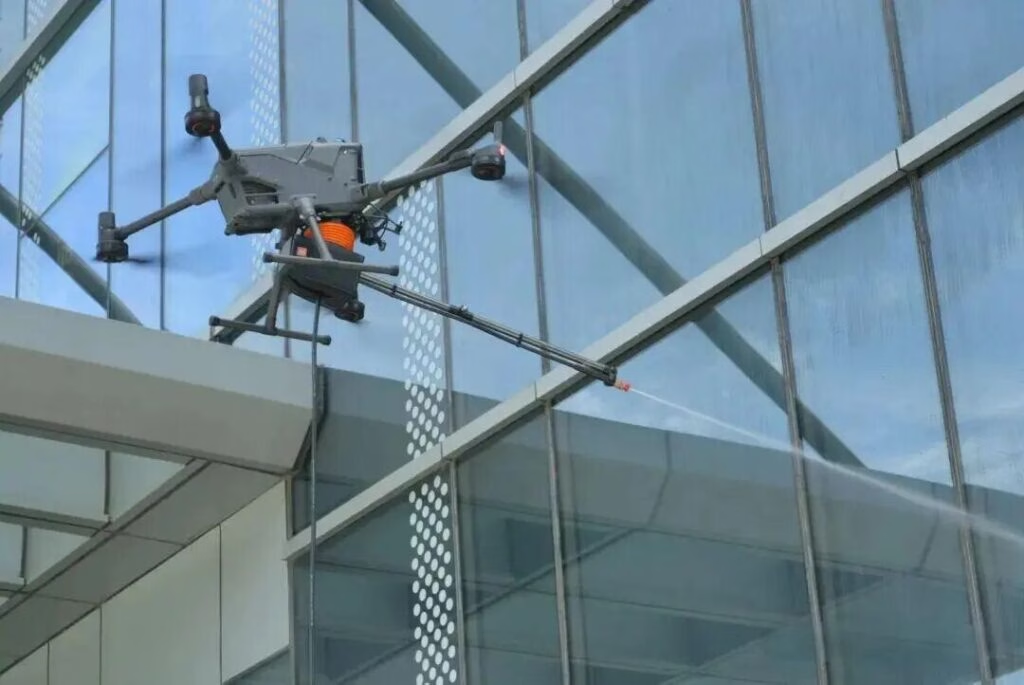
The second pillar is the no-airspace argument. In most of mainland China, flying a drone along a building face above a public street needs airspace approval, and approval timelines kill scheduled maintenance. The C1 is a wall-climbing unit, so it does not enter that queue at all. That single point separates it from the tethered drone systems that dominate high-rise facade work right now, and it is the reason Wisson sells the C1 alongside its drone-mounted AP3-P3 rather than replacing it.
How the Pure-Water Head Actually Works
UltraSoftnic vibrates a soft wiping surface against wet glass. The vibration does the work that a spinning brush or a scraping blade normally does: it disturbs the film of dust, pollen and rain-spot minerals so the water can lift them, and it scrubs without an abrasive contact point. Water carries the load off the glass. No acid, no surfactant, no alkaline gel.
For owners of coated glazing this matters more than the marketing suggests. Low-E coatings, self-cleaning titanium-dioxide films and mirrored spandrel glass are all sensitive to strong alkaline cleaners and to hard scraping; a maintenance contractor that reaches for an acid-based descaler can permanently dull a facade, and the repair is a panel replacement. A pure-water head removes that failure mode from the list. It also removes the run-off question, which is why hospital, school and heritage-adjacent buildings are the natural first buyers — Wisson’s own case work leans heavily on hotels and commercial towers with people directly underneath.
Where It Fits Against Drones and Rope Access
Three facade cleaning methods compete, and they are not interchangeable.
| Method | Throughput | Biggest constraint | Best on |
|---|---|---|---|
| Tethered cleaning drones (e.g. Wisson AP3-P3) | 600–800 m²/h | Needs airspace clearance; grounded above roughly 10 m/s wind | Tall, open, flat facades |
| Rope access crew (two-man) | 80–120 m²/h | Fall risk and insurance cost | Awkward geometry, one-off jobs |
| Wall-anchored robot (Orion C1) | Not published | Anchor method and water feed | Occupied towers with dense glass |
Throughput figures for drones and rope access are industry ranges; Wisson has not published a cleaning rate for the C1 itself.
Wisson’s own project material makes the man-vs-machine gap concrete: on a university research building, a two-person crew with one pilot and one observer took two hours for a glass facade section; the robot team finished the same work in 40 minutes, roughly six times faster, with total cost down about 35%. That is a vendor number from a vendor case study and should be read as an upper bound, but the shape of it matches what every facade operator reports.
What Wisson Does Not Publish — And Why It Matters
Here is the honest gap. Wisson’s product page for the C1 leads with architecture and application footage, not a datasheet. There is no published cleaning rate for the C1 specifically, no weight, no vertical reach, no water consumption per square metre, no IP rating, no price. The 800 m²/h figure widely quoted for Wisson belongs to the drone-mounted AP3-P3 system, not to the wall robot, and anyone comparing the two on a tender document needs to keep them apart. That gap is the main reason this review scores 4.3 rather than higher — the engineering story is strong, but a buyer cannot audit it on paper.
That is not unusual for Chinese facade robotics, where the sales motion is a service contract rather than a spec sheet. Wisson runs a service brand, 汎汐 (Fanxi), that delivers cleaning as an operation with its own crews. But if you are buying the machine outright, the missing numbers are exactly the ones your procurement team will ask for, and getting them in writing before signature is the difference between a pilot and a lawsuit. Ask for the vertical travel limit, the water inlet pressure window, the wind rating, and the anchor load per fixing point.
Which Buildings Suit It, and Which Do Not
The C1 is a good match for flat or gently profiled curtain wall on towers where you already have a maintenance routine, a rooftop water supply and a facade that is mostly glass. Hotels, hospitals, office towers in dense downtown blocks and heritage-adjacent buildings where chemical run-off is a public-relations problem all fit. It is a poor match for anything with deep, irregular ornamentation, for single-storey atriums and skylights, and for small sites where mobilising an anchored robot is slower than sending one person up a ladder — for those, a cordless pane robot stays the better tool and you can compare the current options in our skylight robot reviews.
What to Verify Before a Pilot
- Anchor method. Ask whether the unit needs drilled fixing points or uses existing facade features. Drilled anchors on a sealed curtain wall create a water-ingress risk that must be re-sealed after every campaign.
- Water supply. Pure-water cleaning needs a filtered feed, usually from a rooftop tank through a de-ioniser. On a 30-storey tower the hose run and pump head are part of the job cost, not an accessory.
- Trial panel. Clean one 20 m² panel of the actual glazing, then examine it under raking light for micro-scratches and drying marks. A soft vibrating pad is low-risk, but “low risk” is not “no risk” on coated Low-E glass.
- Service model. Wisson’s strength is the Fanxi service operation, not necessarily the box. If you want a robot, price the machine plus training plus spares; if you want clean glass, price the contract.