
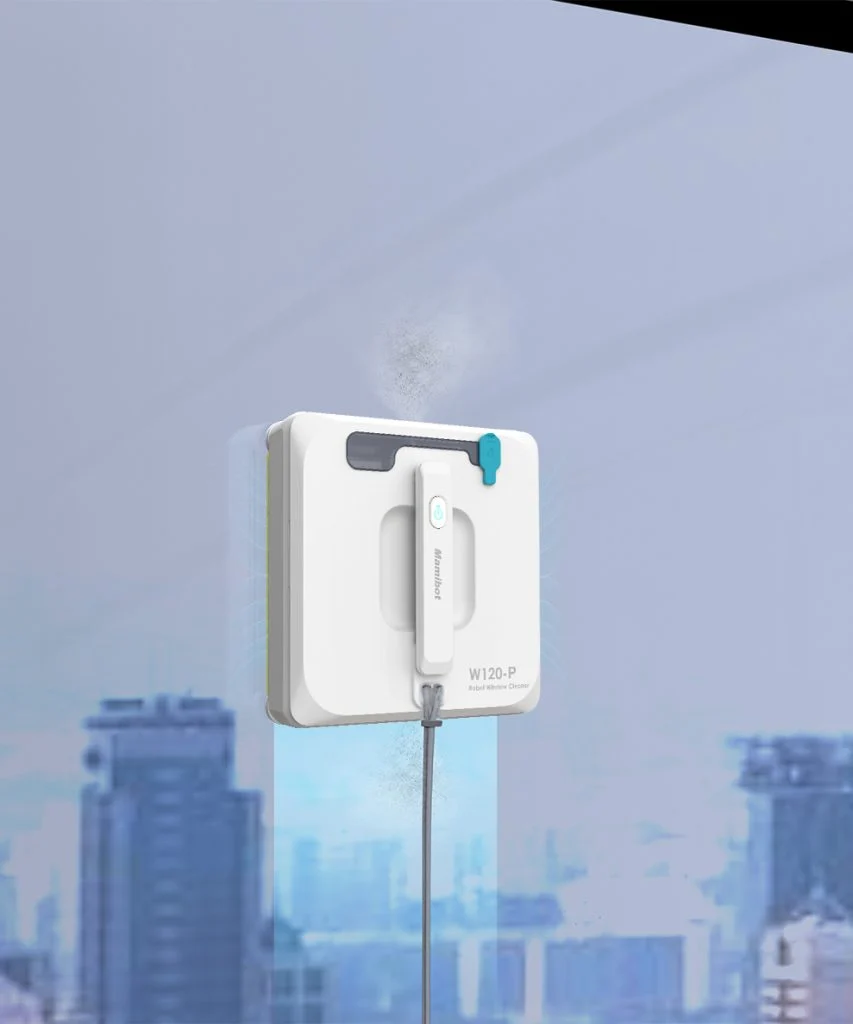
A roof cleaning robot in 2026 costs $1,200-3,500 for a consumer window unit, $5,000-12,000 for a commercial skylight machine, $18,000-45,000 for facade-grade units, and $60,000+ for a rooftop rig system.
Prices for roof cleaning robots in 2026 spread across four bands that barely overlap, and the confusion in the market comes from comparing across them. A $2,000 consumer window robot and a $12,000 skylight machine are not competing products. They differ in vacuum margin, tether rating and duty cycle.
What are the four price bands?
| Band | Price | Typical duty | Lifespan |
|---|---|---|---|
| Consumer window | $1,200-3,500 | Home use, seasonal | 2-3 years |
| Commercial skylight | $5,000-12,000 | Weekly, 300 m² caps | 4-6 years |
| Facade grade | $18,000-45,000 | Daily, high rise | 6-8 years |
| Rooftop rig system | $60,000+ | Continuous, 150 m+ | 8-12 years |
The jump from band two to band three is the steepest, and it is mostly about the tether, the anchor system and the rated duty cycle — not cleaning quality. A $6,000 unit and a $30,000 unit can clean a pane equally well on day one. The difference shows in month 30.
Why is the gap between bands so large?
Three reasons. The seal and pump assembly on a facade unit is built for 4,000+ hours rather than 800. The tether and fall arrest hardware carries certification that costs money to obtain. And the drive train runs continuous-duty motors instead of intermittent ones. Each adds cost in a way that a spec sheet compresses into one suction number.
There is a less comfortable reason too. Low-volume products carry higher margin. A skylight robot selling 400 units a year cannot amortise tooling the way a consumer appliance can, so buyers pay for the low volume as much as for the engineering.
What costs do quotes leave out?
- Seals. $80-400 each, replaced every 800-1,200 hours. A weekly commercial job uses one per year.
- Belts and idler wheels. $120-350 per set, 12-18 months.
- Batteries. $250-900, 18-30 months depending on chemistry.
- Labour. A two-person setup and teardown is 25-50 minutes per site visit. That is often larger than the annual parts bill.
Add it up for a weekly skylight job: about $600-1,200 a year in consumables on a $9,000 machine. Over five years that is 40-60% of the purchase price again, and it never appears in the comparison table.
How fast does it pay back?
Against rope access at $4-9 per m² in Western Europe, a 1,200 m² skylight cleaned quarterly costs $19,000-43,000 a year. A $9,000 robot plus $1,000 in consumables and $6,000 in operator time comes in under that in the first year. The payback is real — but only above roughly 700-800 m² of glass cleaned at least quarterly.
Below that, the crew wins. A 400 m² canopy cleaned twice a year does not justify a machine, and buying one anyway is the most common purchasing mistake in this category. Our Lingkong K3 review works through the payback on a mid-size facade, and all skylight robot reviews carry the same cost model if you want to check a specific unit.
Is buying used a reasonable option?
Sometimes, with conditions. Ask for the hour meter, the seal replacement history and the battery cycle count. A 3-year-old commercial unit with 1,500 hours and no seal history is a $600-1,200 repair waiting to happen. A retired rental unit with documented servicing at 40% of new price can be a genuinely good buy, especially if spare parts are still stocked.
What you should not do is buy used consumer hardware for skylight duty. It was never built for the slope load, and secondhand purchases strip the warranty you would need when it fails.
Does machine size change the price much?
Less than buyers assume. Within a band, a wider brush adds $400-1,200 but the seal, pump and tether — the expensive parts — stay roughly the same. That is why a 400 mm unit and a 600 mm unit from the same maker often sit within 15% of each other. Buy the width your panes actually need rather than the one on sale.
Above 600 mm the arithmetic changes, because the chassis needs a second pump to keep seal load even, and that step is a genuine price jump — usually 30-45%.
What about the service contract?
Quoted separately and usually underpriced in the first year and overpriced after that. A typical 2026 quote is $800-2,000 a year for a commercial skylight unit, covering two visits. Most of what those visits do is inspect belts and seals — work an in-house technician can do with a checklist in 30 minutes. For a single machine, skip the contract and buy the parts. For a fleet of five or more, the contract starts to make sense because travel time dominates.
The quote structure also hides currency and shipping risk. A unit quoted FOB Shenzhen at $8,000 lands at roughly $10,400 in Rotterdam by the time freight, insurance, duty and VAT are counted — and the buyer usually assumes the $8,000 is the number. On small orders that 30% spread decides whether the payback calculation works at all. Get a landed quote, not an FOB one, before comparing to a rope-access contract.
Key Takeaways
- 2026 roof cleaning robot prices run $1,200-3,500 consumer, $5,000-12,000 commercial skylight, $18,000-45,000 facade, $60,000+ rig.
- Consumables add $600-1,200 a year on a commercial skylight machine — 40-60% of purchase price over five years.
- Payback beats rope access above roughly 700-800 m² cleaned at least quarterly.
- Quarterly cleaning of 1,200 m² runs $19,000-43,000 a year at $4-9 per m², which is the comparison to make.
- Used commercial units are viable with a documented seal and battery history; used consumer units are not.