
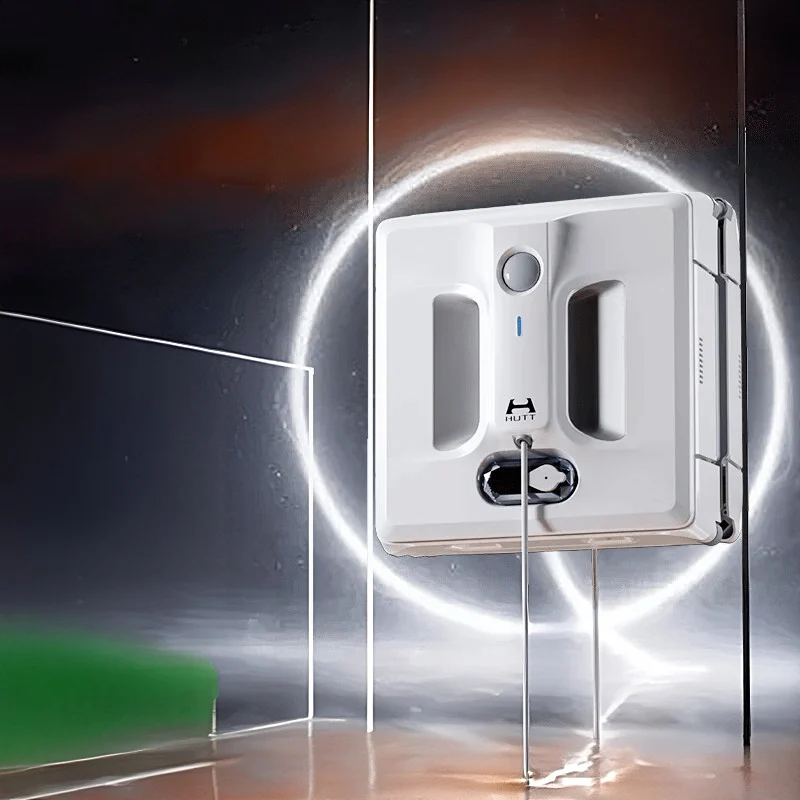
ECOVACS window cleaning robots suit flat vertical glass under 30 m² per pane and glass doors; they struggle on pitched skylights above 30 degrees and on frameless glass with no edge for the fall sensor.
The ECOVACS name shows up in every window robot search, and for good reason: the WINBOT line has been in retail channels long enough to have real failure data. What it does not have is a skylight product. Buyers who assume otherwise end up with a machine that works well on a window and badly on a glass roof.
What is an ECOVACS window cleaning robot good at?
Flat, vertical, single-pane or divided-light glass. The WINBOT family is built around a dual suction pad and a mechanical edge stop, and that combination is genuinely good at 3-25 m² of vertical glass — office windows, shopfronts, glass doors, interior partitions. The retail availability also means service is easier than with an imported skylight unit.
Two specifics worth knowing for 2026. First, the sprayed-water models need a clean reservoir and a filter check every few runs, or nozzles clog and streak. Second, the tether is a genuine safety component, not a marketing accesssory — read the anchor instructions before the first run.
Where does it stop working?
Pitched skylights above 30 degrees. A vertical pane lets gravity work with the suction; a pitched pane pulls the body down the slope and the seal load redistributes. Units designed for vertical glass lose holding margin quickly there, and the recovery tank design assumed water travelling down, not back into the seal. If your roof is a 35-degree atrium skylight, this is the wrong product family.
Frameless or butt-jointed glass is the second limit. The edge stop relies on hitting a frame. On a frameless balustrade or a structural glazed facade with silicone joints, there is nothing to hit, and the fall sensor becomes the only line of defence. That is a thinner margin than most facility managers assume.
Which model fits which job?
Short answer: W3 for larger panes and heavier soil, W2S PLUS for mixed residential glass, mini 2 where panes are small or subdivided. All three share the same edge-stop logic, so the model choice is about size and water capacity, not capability tier.
| Model | Best pane size | Strength | Weak spot |
|---|---|---|---|
| WINBOT W3 | 8-30 m² | Soil handling, spray coverage | Heavy for high reach |
| WINBOT W2S PLUS | 3-15 m² | Household balance, price | Small reservoir |
| WINBOT mini 2 | 1-6 m² | Divided lights, interiors | Slow on big panes |
Our ECOVACS WINBOT W3 review covers the 2026 soil-handling behaviour in detail, and our WINBOT mini 2 review is the fairer read if you have divided-light windows and a tight budget.
Is an ECOVACS robot a skylight solution?
No, and buying one for a skylight is the most common mismatch we see. Skylight duty needs three things the retail line does not design for: a vacuum margin sized for gravity along the slope, a recovery edge that works when water runs back toward the seal, and a tether routing that survives a 4-8 m vertical drop. Those are the design axes of purpose-built skylight machines.
That does not make ECOVACS bad. It makes it a window robot. If you have a glass roof, start with our Lingkong K3 review — it is the closest reference we have for high-rise facade and pitched glass duty — or browse all skylight robot reviews and compare the pitch limits side by side.
What should you check before buying?
- Pane width above 400 mm and below the rated maximum, with a frame on all sides.
- Window sill or reveal depth — the tether needs a straight drop, not a kink over a ledge.
- Ambient temperature at the time of use; below 5 °C the seal compound stiffens and holding force drops.
- Water quality. Hard water above 200 mg/L leaves mineral spots the squeegee cannot lift.
- Spare filter and seal availability in your country, not just on the maker’s site.
One more thing, and it is the item that decides satisfaction more than any spec sheet: how often you will actually run it. A robot that takes 4 minutes of setup per pane only pays off if you clean at least four times a year. Under that cadence, a squeegee and a pole remain the better tool, and no amount of suction changes the arithmetic.
How does it compare with a purpose-built skylight unit on price?
Retail ECOVACS units sit far below commercial skylight machines, and that gap is honest — they are solving different jobs. A consumer window robot for a home with regular casement windows is good value. The same budget spent on a fractional skylight machine buys nothing usable. Know which job you have before looking at price.
One operational note for facility teams: log every run. Suction cycles, edge stops, filter changes. Units that get four times the rated usage in a commercial setting fail earlier than the consumer warranty assumes, and a log is how you argue a claim without guesswork.
Key Takeaways
- ECOVACS window robots are vertical-glass machines; on skylights pitched above 30 degrees the holding margin collapses.
- Edge-stop logic needs a frame — frameless or butt-jointed glass leaves the fall sensor as the only defence.
- W3 suits 8-30 m² panes, W2S PLUS 3-15 m², mini 2 subdivided lights under 6 m².
- Below 5 °C the seal stiffens and holding force drops about 15%; winter use needs a different seal compound.
- If you clean fewer than four times a year, a water-fed pole beats any robot on cost per clean.