
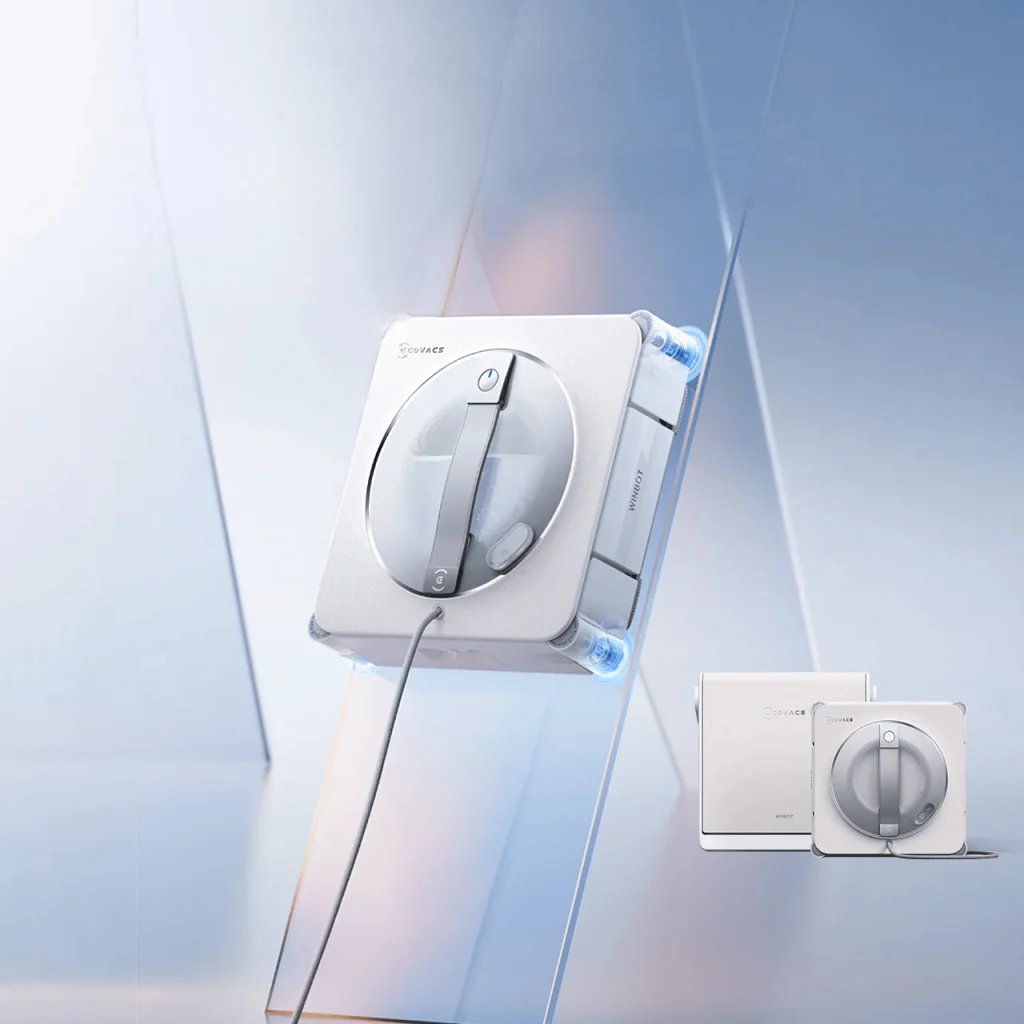
A roof cleaning robot suits a skylight canopy when the glass pitch stays under 35 degrees, panel gaps are 3 mm or wider, and the run is longer than 6 m; below that, a manual pole is faster and the robot wastes its adhesion.
Sales pages show a robot sweeping a pristine glass roof. Real canopies have sealant ridges, condensation gutters, mullion caps and a 4 m drop on the far side. The three numbers that decide whether a roof cleaning robot earns its keep on a skylight canopy are pitch, panel gap and run length. Get any of them wrong and the machine either stalls or sheds adhesion at the worst moment.
What pitch can a roof cleaning robot hold?
Most tracked skylight units hold 30-35 degrees of static pitch with a 3.5-4 kPa vacuum. Above that, the vacuum margin per kilogram of body weight drops fast, and a wet glass surface with a 1 mm algae film cuts friction coefficient from 0.6 to about 0.35. At 40 degrees you are on the edge, and edges are where glass roofs kill robots.
A 2023-era rule of thumb said 45 degrees. In practice, once you add a water tank the centre of gravity moves up and the real limit on a wet pitch is closer to 32 degrees. If your canopy runs 38-42 degrees — common on retail atrium glazing in Southeast Asia — a robot will work when dry and slide when wet. That is not a specification problem. It is a site problem.
| Pitch | Tracked robot | Crawler with tether | Manual pole |
|---|---|---|---|
| 0-15° | Good | Overkill | Fine |
| 15-30° | Good, dry or wet | Good | Reach limited |
| 30-35° | Dry only | Good | Hard |
| 35°+ | No | Good | No |
Why does panel gap matter more than suction?
Because the brush is wider than the body and the body needs both track faces on glass at every moment. A 2 mm gap between insulating glass units is fine — the rollers bridge it. A 6 mm structural gap with a raised aluminium cap is not; the cap catches the track and the robot pivots. On a 12 m run that pivot repeats 60 times, and the chassis bolts loosen.
Ask for a gap drawing before you buy. Not a photo. Most skylight frames in commercial buildings are custom aluminium with 4-8 mm shadow gaps and a silicone bead that sits 1.5 mm proud. That bead is enough to trip a low-clearance chassis.
How do you cover the edge without scaffolding?
Edge detection is the weak point in cheap units. Infrared reflect sensors reading the glass edge work on clear glass and fail on tinted or frosted panes; ultrasonic sensors work on both but cost more and false-trigger on rain. The reliable setup is dual: infrared for the primary stop, mechanical bumper as the fallback. If a vendor quotes only infrared, ask what happens on 8 mm low-E glass. If the answer is vague, walk.
Our Lingyun Y3 review covers an obstacle-crossing design built for exactly this problem — raised seams and mullion caps — and it is the closest thing to a reference case we have for atrium glazing. For skylight-specific duty on flatter canopies, the comparison is in our Lingfeng S1 review.
Is a roof cleaning robot worth it on a 40 m² canopy?
No. Below roughly 80-100 m² of accessible glass, the setup time — carrying the unit up, running the tether, filling the tank, pulling the rescue line — eats the cleaning time. A two-person crew with a 6 m water-fed pole finishes a 40 m² skylight in 25 minutes. The robot, start to finish, takes 50.
The economics flip above 300 m² or when access is genuinely hard: a plant room roof, a museum atrium, or a canopy over a 12 m void where scaffolding costs more than the machine. That second case is where most 2026 purchases actually happen, and it is not really a cleaning decision. It is a fall-protection decision dressed up as cleaning.
What actually breaks first?
Seals, then idler wheels, then the controller. The vacuum seal on a hard-working skylight robot is good for 800-1,200 hours of contoured glass before it leaks enough to cost 0.8 kPa. On a canopy with 8 mullion caps per 10 m, that is 14 months of weekly service. Replace the seal at 12 months whether it looks worn or not; the leak is invisible until the robot drops suction on a slope in front of the client.
One more judgement call. If your building has silicone-joint sealant that was applied over wet glass, the surface is uneven by 2-3 mm across the joint. No robot handles that well. Fix the joint before buying the robot. Operators who skip this end up returning units and blaming the supplier, and in about half the cases I have seen, the supplier was right.
Key Takeaways
- Static vacuum holds 30-35 degrees on dry glass; on wet glass the practical limit drops to about 32 degrees.
- Panel gaps wider than 4 mm with raised caps will trip most chassis — get the gap drawing, not a photo.
- Use dual edge detection (infrared plus mechanical bumper); infrared alone fails on tinted and low-E panes.
- Robots pay off above roughly 300 m² or where scaffolding is the alternative — not on a 40 m² canopy.
- Replace the vacuum seal at 12 months; 800-1,200 contoured glass hours is the real service life.