
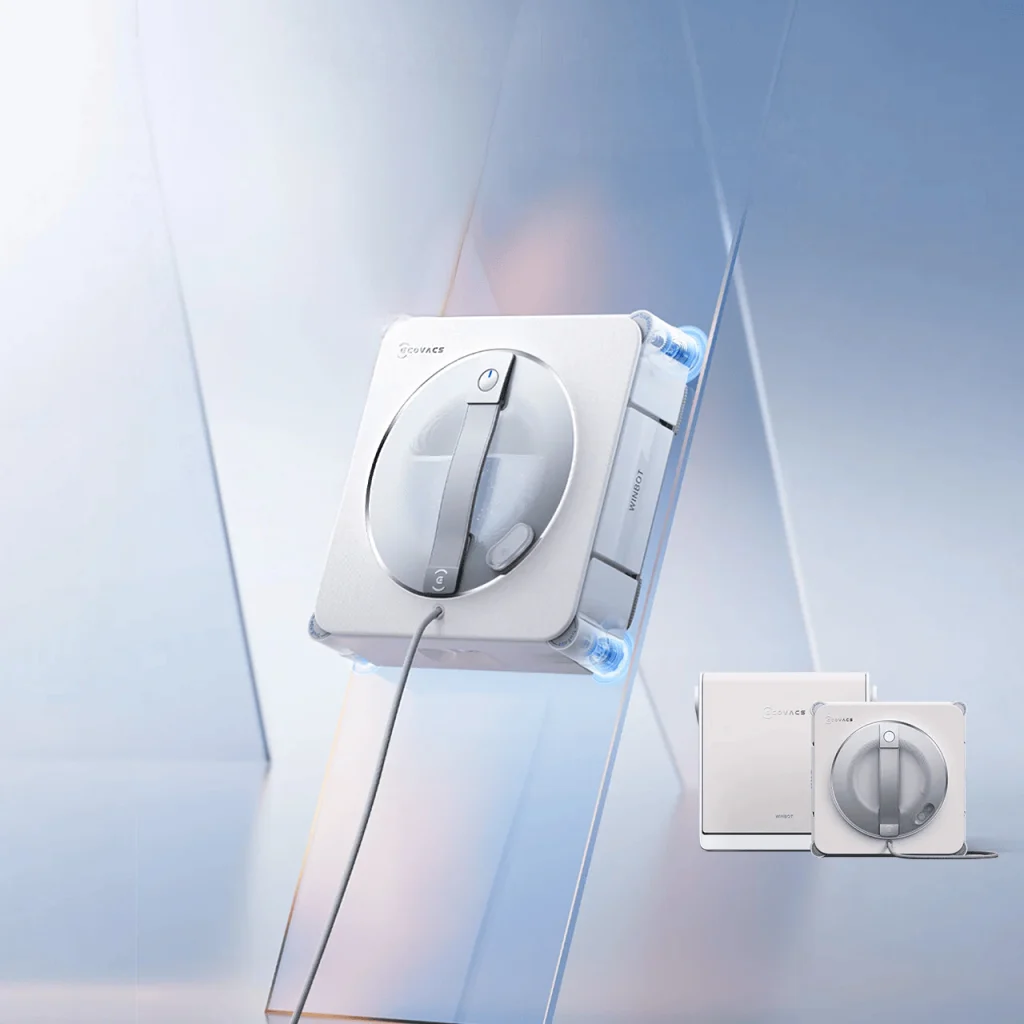
Read window cleaning robot reviews by checking the test surface, not the star rating. A review filmed on clean, flat, dry glass tells you almost nothing about how the same robot behaves on a dusty, pitched skylight over a live atrium.
There are hundreds of reviews in this niche and most repeat the same demo. The useful ones tell you the water consumption, the suction at the end of the run, and what happened when the robot met a frame it did not expect.
What should a useful window cleaning robot review include?
Four numbers. Suction held after 30 minutes, square metres per tank, runtime to a real drop in grip, and the slope the tester actually used. If a review does not state those, treat it as an advertisement.
- Glass type and slope (flat, 15°, 30°, framed, frameless)
- Suction measured at start and at 30 minutes
- m² cleaned per water tank and per charge
- What happened at seams, seals, and open edges
Why do most reviews look the same?
Because the demos are easy to stage. Clean glass in a showroom, one panel, no wind, no dust, camera stops before the last streak. It is not dishonest exactly — it is just the easiest 90 seconds to film. The hard part of this job never makes the clip.
A better frame of reference is a hands-on teardown. Our Mamibot iGLASSBOT W200 SkyBot review walks through the specs and the practical limits rather than a showroom loop.
Do window cleaning robots actually work?
Yes, within a narrow brief. On flat or gently pitched glass up to about 6 m of reach, a robot replaces the risky part of the job — hanging off the glass — and does it in a fraction of the time. On steep or wind-exposed glass, the honest answer is “not alone.”
The failure mode people do not film is suction loss on a wet, dusty panel mid-run. Once grip drops, a robot on a 30-degree skylight starts to slide, and that is when the tether that reviewers ignore earns its keep.
Which robot is best for high-rise work?
For repetitive vertical facade grids, tethered machines hold sustained suction and finish a floor line in a predictable window. For framed roof glass with seams and obstacles, an obstacle-crossing robot is the right class. There is no single winner — the winner is the machine matched to your geometry.
Our Mamibot iGLASSBOT W120-P review covers a compact unit for tighter framing, useful as a contrast against full-size facade robots.
How to filter reviews fast
Skip any review that never mentions weather, water, or a frame. Those three are where the real story lives. Then look for a reviewer who states the slope and the glass type, because that is the one who actually used the machine instead of unboxing it.
How should you judge a review’s test setup?
Ask one question: did the tester clean dirty glass at an angle? If the answer is yes, the review is worth your time. If the robot only ever met clean, flat, horizontal glass on a workbench, you have learned what the box looks like, nothing more.
The other tell is whether the reviewer mentions the tether. Reviewers who ignore it have never run a machine near a drop. On any job over a live space, the tether is the feature that matters, and a review that skips it is a review written without skin in the game.
What is a realistic performance baseline?
For a mid-range robot on framed glass at up to 20 degrees, a fair expectation is 40–70 m²/h in a real cycle including repositioning, with grip holding for 30–45 minutes before a noticeable drop on a dusty panel. Anything advertising double that is quoting a clean-glass sprint.
Use that baseline as your filter. Reviews that report numbers near it are credible; reviews that report triple it are describing a different machine than the one you will receive.
How do you separate a paid review from a real one?
Look for the downsides. A genuine review names at least one thing the robot does badly — streaks on the last pass, a slow return to dock, a filter that clogs fast. A review with no criticism is either a paid placement or written after five minutes of use.
Then check longevity. The best reviews are updates: “six months on, here is what changed.” A robot that impressed on day one and slipped on wet glass by month three shows up in the follow-up, never in the launch clip.
Which specification questions should a review answer?
Suction in pascals, both at start and after thirty minutes. Water tank in litres and coverage per full tank. Slope range. Tether or no tether. And the consumable prices. A review that answers those five is doing real work; one that leads with camera quality or app design is selling a phone, not a cleaning machine.
If a review cannot tell you the consumable prices, that is itself information. It usually means the reviewer did not buy the parts, because the parts are boring and the launch video is not.
Key Takeaways
- Judge reviews by test conditions, not star ratings.
- Demand four numbers: held suction, m² per tank, runtime, and slope tested.
- Robots work well on flat to 15° glass; steep, wind-exposed glass still needs a tether.
- Ignore any review filmed on showroom glass with no weather and no frames.
- Compare classes, not brands, using all skylight robot reviews.