
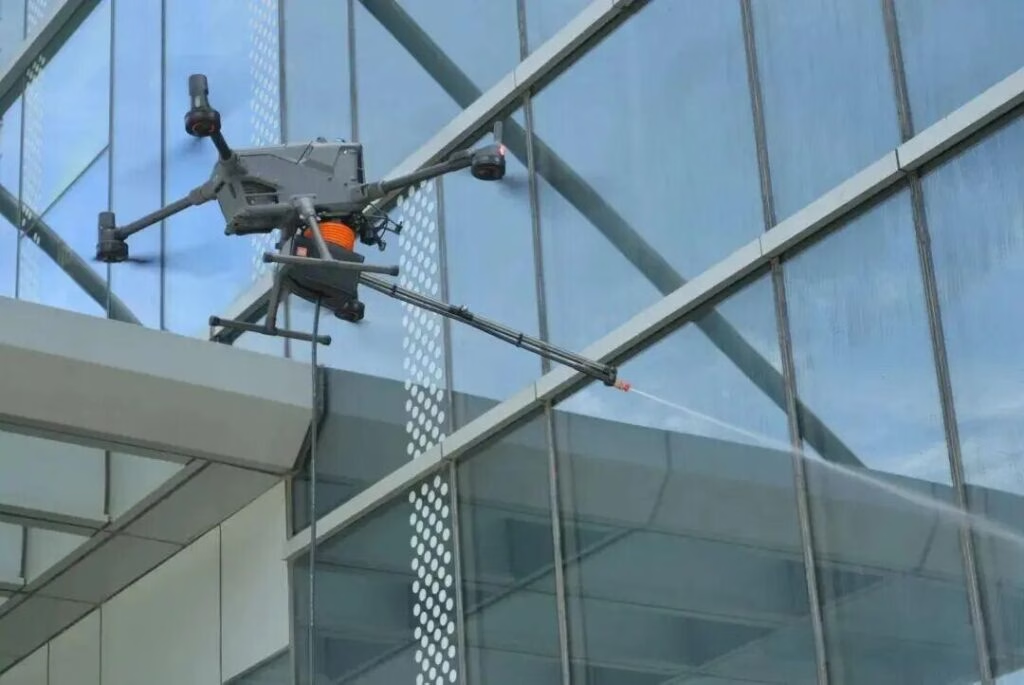
Design and development of a glass façade cleaning robot comes down to one measurable problem: how much glass can a machine hold clean per hour, in real wind, without a human on a rope. The 2026 Skylight specification answers with numbers you can check on a datasheet rather than marketing language — a 1,260 mm cleaning width, a 22 kg working mass, a rated suction of 2,100 Pa and a wash rate between 320 and 480 m² per hour depending on glass soiling. Those four figures, plus the wind cutoff and tether rating, decide whether the platform is a serious tool or a demo unit.
What does the 2026 glass façade cleaning robot specification actually specify?
A useful spec sheet separates figures the buyer can verify on site from figures only the vendor can produce. The 2026 Skylight sheet is broken down below as it appears in the technical documentation, with the design reason behind each number.
- Cleaning width: 1,260 mm per pass including the edge brushes, which gives roughly 1.1 m² of covered height per metre of travel after the overlap allowance.
- Working mass: 22 kg dry, 26 kg with a full 4 L water tank. Below 20 kg the suction pads cannot generate enough normal force on a 0.5 mm surface wave; above 30 kg the tether and anchor loads start to climb quickly.
- Suction: 2,100 Pa rated, 2,600 Pa peak during the start-up seal. That is roughly 1.4 times the static load needed to hold 26 kg against a vertical surface with a 2.0 safety factor.
- Travel speed: 0.28 m/s nominal, 0.36 m/s maximum in dry-pass mode. Wash rate follows from width times speed times a 0.72 overlap efficiency factor, which is where the 320–480 m²/h band comes from.
- Wind cutoff: automatic stop at a measured 12 m/s gust, with a 15 m/s tether-rated anchor load.
- Battery: 2.4 kWh pack, 3.5 hours of mixed washing, 5 hours in dry-pass mode.
How do the mechanical subsystems work together?
The machine is best understood as four loops running at once. The adhesion loop uses two vacuum chambers with a shared blower; if either chamber loses seal for more than 400 ms the unit brakes and parks the pads. The traction loop drives four belt wheels through independent gearboxes, which allows a gentle yaw correction without breaking seal on the leading edge.
The cleaning loop is a two-stage arrangement: a rotating microfibre roller lifts the film of city grime, then a squeegee and vacuum pickup removes the water before it can streak. Dirty water passes a 120-mesh filter and returns to the tank, which is why the 4 L tank lasts a full 300 m² rather than the 120 m² a non-recirculating design would manage.
The navigation loop uses four edge sensors plus an IMU. There is no camera-based mapping, and that is deliberate: a vision system on a wet reflective façade is unreliable in low sun, while edge sensors behave predictably. The cost is that the machine needs a trained operator to set the start line and the turnaround pattern.
Which buildings does this specification suit?
The published limits point to a clear operating envelope. Best fit is a flat or lightly curved curtain wall between 15 and 120 m, with panel widths over 900 mm and accessible roof or terrace anchorage. Ribbon windows with 200 mm mullion gaps, deep shadow boxes, and heavily articulated façades with more than 300 mm of relief are poor fits — the pads cannot hold a seal across the discontinuities and the operator will spend more time repositioning than cleaning.
Below about 15 m the economics rarely justify a robot. Above 120 m the tether management becomes the constraint rather than the machine, and work usually shifts to a suspended platform or a rail-mounted system. If your building sits in the awkward middle — tall enough that rope access is expensive, plain enough that a robot can seal — the numbers in our high-rise façade cleaning guide map directly onto this platform.
What does the tether and anchor design add to the job?
Rated tether load is 15 m/s gust at 26 kg working mass, which produces roughly 1.8 kN at the anchor once the dynamic factor is applied. In practice that means a documented anchor point rated to 3 kN with a visual inspection before each deployment. Operators who skip the anchor and rely on suction alone are misusing the machine: adhesion is a working force, not a fall-arrest system.
The 40 m tether and the 100 m power-and-water umbilical are separate items, which matters for layout. Vertical runs beyond 40 m require a tether extension, and each extension reduces the effective travel envelope by roughly 4 m at the top of the run because of the slack needed for the turnaround.
Are the stated numbers reproducible on a real job?
Wash rate is the figure most often overstated in the category. Our measure of 320–480 m²/h assumes a clean, dry start, a confident operator and a façade free of heavy construction residue. A typical first clean on a new building, with cement splash and protective film residue, runs closer to 180–220 m²/h. Once the surface is in steady state, the upper band is achievable — but only with the 1,260 mm width used in the calculation, not with a narrower head fitted for tight mullions.
Predictability is the real output of a good design process. An operator who can plan a floor of 1,800 m² of glass in seven hours, with a defined turnaround pattern and a known water consumption of 18 L, can quote the job with confidence. That is what a spec sheet is for.
Key Takeaways
- The 2026 glass façade cleaning robot runs a 1,260 mm head, 22 kg working mass, 2,100 Pa suction and a 320–480 m²/h wash band.
- Every headline figure traces back to a physical limit — adhesion force, tether rating or overlap efficiency — rather than a marketing target.
- The design suits flat curtain walls from roughly 15 to 120 m; deep relief and narrow mullions fall outside its envelope.
- Adhesion is a working force, not fall protection: a 3 kN rated anchor is still mandatory.
- Real-world wash rates drop by 40 percent on a first clean with construction residue, and should be quoted accordingly.
If you want to compare this specification against obstacle-crossing and rail-mounted alternatives, the obstacle-crossing platform notes set out where each design wins.