
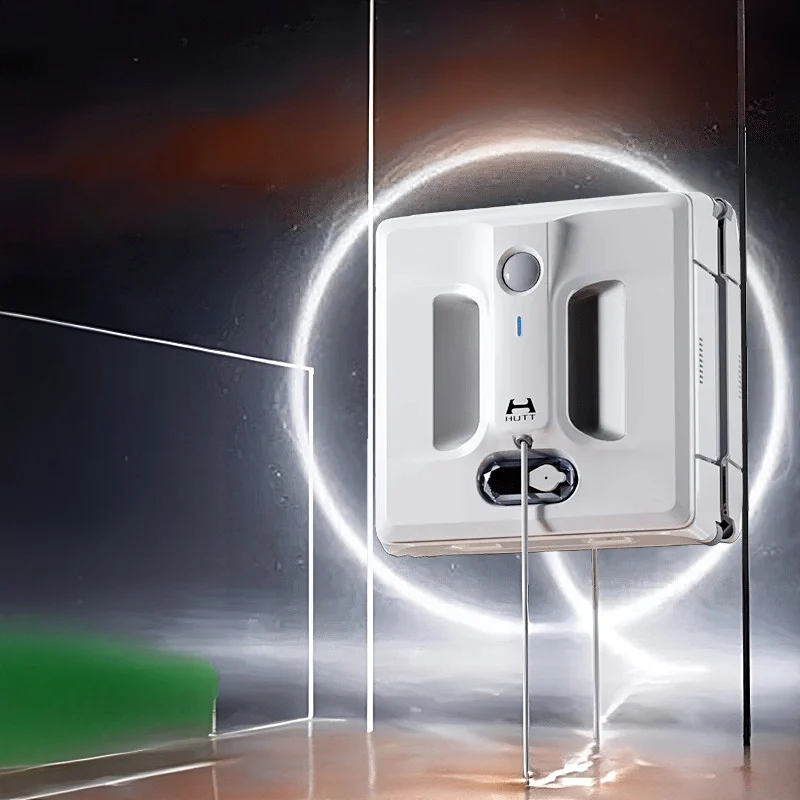
Windows too high to reach in 2026 get cleaned one of four ways: a telescopic pole up to about 10 m, rope access crews for irregular and tall facades, drones for rinse and pre-wash passes, or robots for large uniform glass. Choose by height, glass area, and how often you need it done — not by which method sounds most modern.
“Too high to reach” is a vague phrase that hides four different problems. A 9-meter atrium window and a 90-meter curtain wall are not the same job, and the tool that works for one fails at the other.
What are the real options for high windows?
| Method | Practical height | Best for | Cost signal |
|---|---|---|---|
| Telescopic pole | Up to ~10 m | Occasional, simple glass | Lowest |
| Rope access crew | Any height | Irregular, detailed work | High per visit |
| Drone | Up to ~100 m | Rinse, pre-wash, hard access | Medium |
| Robot | 1-300 m | Large, uniform, repeated | High upfront, low per run |
The pole is underrated for domestic work. A good 8-meter pole with a water-fed brush cleans a two-story house without a ladder or a robot, for a few hundred dollars. People leap to robots before trying the boring option.
When is a robot the right call?
When three conditions hold: the glass is a large, mostly uniform surface, you clean it often, and reaching it otherwise is expensive or unsafe. Malls, airports, factories and office towers with big glazed areas fit this well. Robots also cut the human risk of rope work, which is a real and documented hazard.
The economics turn on frequency. Cleaned once a year, a robot almost never pays back. Cleaned quarterly or more on a large surface, it usually does. A tracked skylight robot covering 150-250 m² per hour against a rope crew at 60-100 m² per hour is not a close race on a big roof.
If you are evaluating specialty machines for roof glazing, the Lingfeng S1 review shows the obstacle-crossing behaviour that matters when glass is broken up by frames and seams, which is the norm on real roofs.
Where do drones still fall short?
Drones spray. They do not apply firm, controlled contact the way a squeegee does, so they leave streaks unless a person or robot does a finish pass. Drones also have regulatory constraints in many cities and struggle with wind at height. Use them to knock down heavy dirt and reduce how much finish work is needed — not as a complete answer.
What are the safety and compliance basics?
- Rope access needs certified technicians, anchor points, and insurance — expensive but flexible.
- Robots need tether or anchor systems above low heights and IP-rated housings for outdoor use.
- Drones need operator certification and airspace clearance in most jurisdictions.
- Poles carry electrocution and fall risk near power lines and edges; water-fed systems reduce this.
Whatever the method, the ability to stop work in high wind is a compliance requirement, not a preference. Wind is the single most common reason a high-window job gets postponed.
So what is the honest recommendation?
For a house: buy a pole. For a mid-size building cleaned a few times a year: rope crew. For a large glass roof or facade cleaned often: a robot. For a grimy facade before any of the above: a drone rinse first. Most procurement mistakes come from picking a method by novelty rather than by frequency and surface.
If you are still comparing machines before committing, the window and skylight robot reviews gather the models built for high, hard-to-reach glass so you are not comparing a consumer gadget to a commercial machine by mistake.
Key Takeaways
- Four methods cover high windows: pole (~10 m), rope crew (any height), drone (rinse), robot (large uniform glass).
- Robots pay back only when glass is large, uniform and cleaned often, typically quarterly or more.
- Drones handle pre-wash well but leave streaks without a mechanical finish pass.
- Every method needs a documented high-wind stop-work rule for compliance.
- The most common error is choosing by novelty instead of by surface area and cleaning frequency.
How do you decide between methods for one building?
Work down a short list. Is the glass reachable by pole? Use the pole for the lower sections. Is the upper glass uniform and cleaned often? A robot pays off there. Is it irregular or historic? Rope access remains the honest answer, expensive as it is. Most buildings end up with a mix, and mixing is more cost-effective than forcing one method everywhere.
The mistake to avoid is buying a single robot to cover both a ground-floor shopfront and a 40-metre tower face. They are different jobs, and one machine does neither well when stretched across both.
What paperwork does high-window cleaning need?
- Risk assessment per facade, updated for weather.
- Operator certification for rope access and drone piloting.
- Anchor and tether inspection records for robot or rope work.
- Insurance confirmation for overhead work near the public.
- Stop-work procedure triggered by wind, rain or equipment faults.
Frequently asked questions about high windows
What is the cheapest safe option? A water-fed pole for anything under about 10 m. It removes ladder risk and costs a fraction of a robot.
Can drones replace people entirely? Not yet for finishing. They rinse and pre-wash; the streak-free pass still needs contact.
What is the hidden cost of each method?
Every option has a cost that does not appear in the quote. Pole work carries a labour cost that scales with how often you do it. Rope crews carry insurance and scheduling friction. Drones carry regulatory overhead and the reality that someone still has to finish the job by hand. Robots carry maintenance, spares and training. Picking well means knowing which hidden cost you can live with.
For buildings that cannot tolerate closures, robots and poles push most of the disruption out of working hours, which is worth more than the headline saving on a crew. For one-off jobs, that advantage disappears and the cheapest safe method wins outright.