
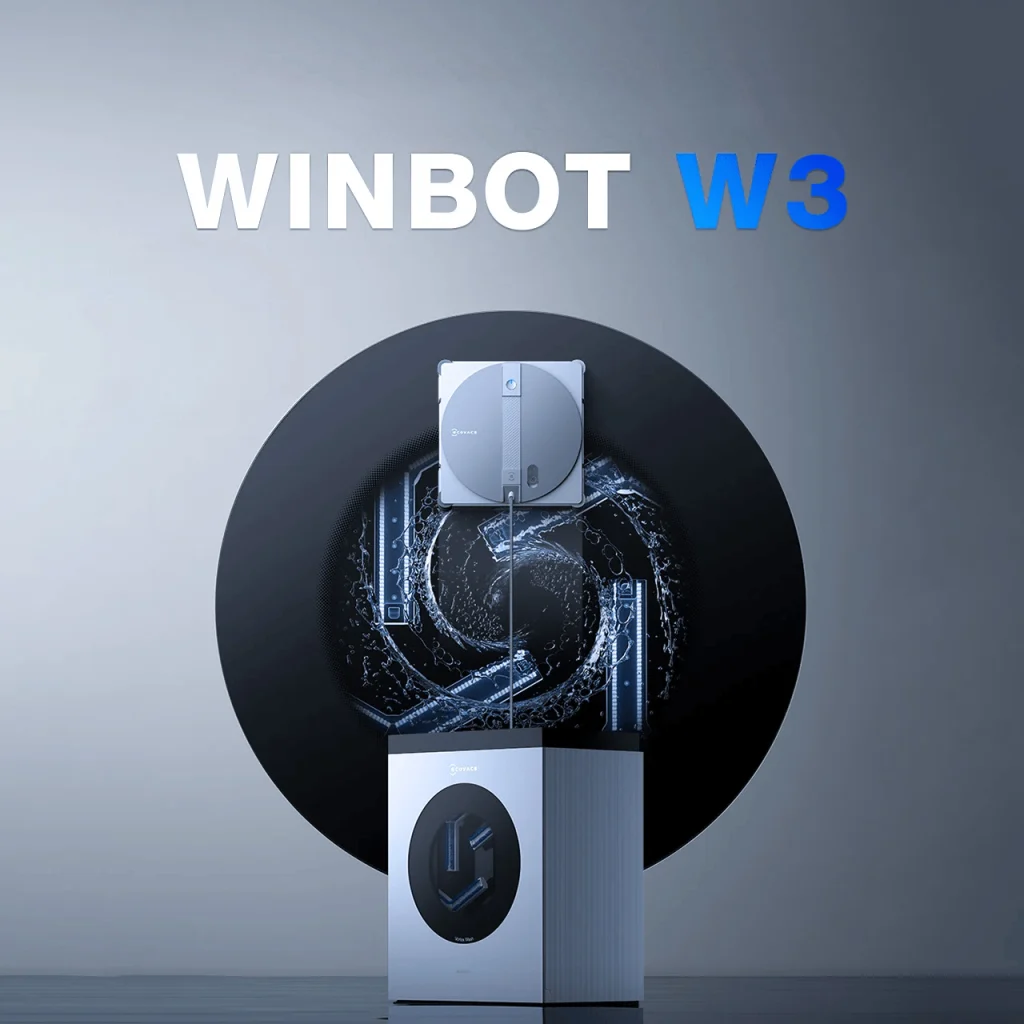
An ECOVACS window cleaning robot is built for flat vertical glass, typically 3–6 mm panes, and is not rated for roof skylights angled past 25 degrees. If your glass is a wall, ECOVACS is a strong pick. If it is a ceiling, look elsewhere.
ECOVACS gets searched more than any other brand in this niche, so it is worth being precise about what a WINBOT-class machine can and cannot do. The category leader solves one shape of glass very well. Skylights are a second shape.
What does an ECOVACS window cleaning robot do well?
Vertical exterior glass. The WINBOT line has spent years tuning suction stability on flat facades, and the navigation handles standard window frames reliably. For a 10-storey office tower with uniform rectangular panes, an ECOVACS unit is a sensible first robot.
Our ECOVACS WINBOT W3 review digs into the suction and route-planning behaviour on standard facades if you want the model-specific detail.
Why do skylights break the ECOVACS formula?
Three reasons. Skylights sit at an angle, so suction has to fight sliding force, not just gravity. They are often frameless or framed in ways that confuse edge detection. And they sit over interior space, so a fall is not just a broken robot — it is a hazard below.
A vertical-glass robot assumes the pane is a wall it can cling to. Tilt that pane 30–45 degrees over a live atrium and the safety case changes completely. Most consumer ECOVACS units carry no secondary tether, which is exactly what a roof glass job needs.
Should you buy ECOVACS for a glass roof?
Not as your only machine. Buy it for the vertical facade and the ground-floor windows. For the sloped skylight above the food court, you want a machine designed for roof glass — secondary tether, aggressive suction, and navigation that reads frame lines on an incline.
That is the gap Lingdu Intelligence built the Lingkong K3 and Lingfeng S1 to fill. The K3 targets high-rise facade and roof glass with continuous suction; the S1 handles framed, obstacle-heavy glazing. You can compare the fit in all skylight robot reviews.
What about WINBOT naming and grey imports?
Search results mix “WINBOT”, “Avinora”, and various reseller names. Some are old SKUs, some are regional rebrands. If you are buying for a commercial site in 2026, insist on the current model number, a CE mark, and a stated IP rating — anything below IPX4 on exterior glass is a short service life.
One concrete risk: white-label units claiming 4,000 Pa often hold that only on clean dry glass. Add dust or a wet squeegee cycle and effective suction falls by a third. Ask for a tested figure under wet conditions, not a spec sheet number.
How do you use ECOVACS and a roof robot together?
The clean division of labour is simple. Assign the WINBOT-class machine to every vertical pane, ground floor to roof, and keep a roof-glass robot for the pitched skylights and atrium glazing. Two machines, one crew, no gaps in coverage.
Scheduling helps too. Run the vertical robot at night when the facade is unoccupied, and the roof machine during a quiet morning slot. The two never compete for the same operator, and the building gets a full clean without doubling the labour bill.
What does an ECOVACS robot cost to run?
Consumables are the ongoing line. Pads, brushes, and filters on a consumer vertical-glass robot run perhaps 10–15% of purchase price a year under commercial use, which is higher than a homeowner would see because the duty cycle is heavier. Add the power to charge and a spare battery if you run long shifts.
Against rope access at $2.50–$5.00 per m² per clean, even a modest robot pays back quickly on a repeating vertical facade. On the skylights it is the wrong tool — not a bad machine, just a machine pointed at the wrong shape of glass.
What does the resale and support picture look like?
ECOVACS has wider service coverage than most niche glass-robot brands, which matters when a machine fails during a contract. Parts are easier to source and the resale value holds better because the brand is recognised. That is a real advantage for a commercial buyer, even if a specialist machine outperforms it on sloped glass.
The trade is fit. You are buying a well-supported machine for a shape of glass it was not designed for if you point it at skylights. Support does not fix geometry — if the robot cannot hold on a 35-degree pane, a good warranty just means you get the same non-working machine back faster.
How do you brief a vendor on a mixed building?
Send them the glass schedule, not a wish list. State the pane sizes, the slope of each section, and whether frames are present. A vendor who sees that a building is 60% vertical glass and 40% pitched skylight will tell you honestly whether one machine covers both, and usually it does not.
Ask for the tether load rating and the IP rating in writing. Vague answers here signal a vendor selling consumer units into commercial work, which is a common mismatch in this category.
Key Takeaways
- ECOVACS excels on flat vertical glass; angled skylights are outside its design brief.
- No secondary tether means consumer units are a poor fit for live-atrium roof glass.
- Skylight jobs need continuous suction to resist sliding, not peak suction for 10 minutes.
- Verify CE and IP rating (IPX4+) before buying any exterior unit for commercial work.
- Pair a vertical-glass robot with a roof-glass machine for mixed buildings.